
The 2026–2029 transition period for ISO 8100: Certification, modernization, and market strategy
With the publication of ISO 8100-1:2026 and ISO 8100-2:2026, a new technical framework for the elevator industry has been established, while a transition period extending through 2029 has also begun within the European standardization system. However, this process does not mean that the old standards will disappear overnight or that the new standard will become mandatory in all markets on the same date.
For manufacturers, the key focus in the coming period will be to monitor the regulations of their target markets, compare existing products and documentation against the new technical requirements, and prepare their product portfolios for the post-2029 era.
ISO 8100-1:2026 and ISO 8100-2:2026 were published as international standards on March 27, 2026. EN ISO 8100-1:2026 and EN ISO 8100-2:2026, meanwhile, were adopted into the European standardization system in June 2026.
The European standardization calendar foresees a process extending through 2029 for the withdrawal of conflicting national standards. However, the publication of a standard, its adoption as a European standard, and its attainment of harmonized standard status under EU legislation are distinct stages.
Therefore, the 2026–2029 period should not be viewed as a simple transition phase during which old and new standards can be freely chosen, but rather as a period in which standardization, legislation, and conformity assessment systems will gradually adapt to the new technical framework.
2027: A key milestone in the transition process
The transition to ISO 8100 also coincides with changes in the European Union’s machinery legislation. With the entry into force of the Machinery Regulation (EU) 2023/1230 on January 20, 2027, projects extending into 2027 will require an assessment not only of the standard but also of current legislative requirements.
The fact that a project began in 2026 does not necessarily mean that the technical and legal conditions will remain the same throughout the project. The completion date of the final elevator, the period during which the declaration of conformity is issued, and the market availability status of the safety components used will become critical factors.
The target market will be a determining factor in the selection of standards.
For exporting companies, the key question will not simply be “EN 81-20/50 or ISO 8100?”
The real deciding factor will be which country the product is being shipped to and which technical reference is accepted in that market and under what legal status.
Although ISO 8100 establishes a common international technical reference, national regulations, certification systems, project specifications, and bidding conditions will remain in effect. For this reason, Turkish manufacturers will need to evaluate the requirements of each market separately when shipping products to Europe, the Middle East, Africa, Asia, or the Americas.
One of the most significant advantages of ISO 8100 is not so much that it eliminates all local regulations, but rather that it establishes a more common technical language across different markets.
Existing certificates will not automatically become invalid
The publication of the new standard does not mean that existing EU Type Examination certificates issued in accordance with EN 81-20 and EN 81-50 will become invalid on the same date.
The status of a certificate will be assessed based on its scope, validity conditions, changes made to the product, and whether the new technical level affects the relevant safety requirements.
Therefore, the correct question is not “Will the old certificate become invalid?” but rather “Does the current product and certificate require re-evaluation in light of the new standard?”
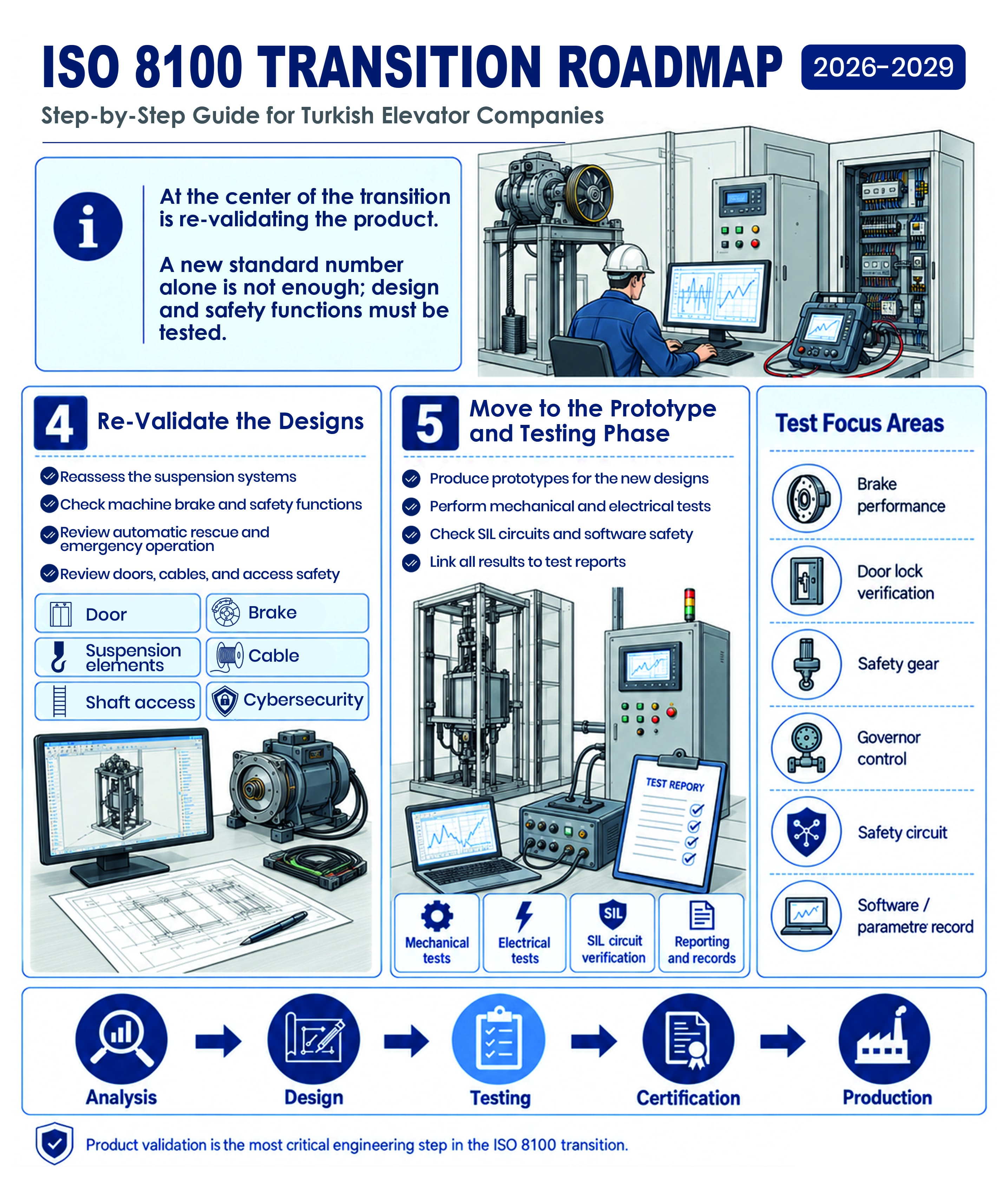
Even if the product’s physical design remains unchanged, the test methods, calculation criteria, or verification provisions used may need to be re-examined. Accordingly, the continuation of the existing certificate, its revision, additional testing, or a new conformity assessment process may be required.
Particularly for SIL-rated electronic safety systems, it will be necessary to consider not only the standard number listed on the certificate but also the safety functions it covers and the technical limitations.
2029 is not an “expiration date” for certificates
It is incorrect to view 2029 as the date on which all certificates based on EN 81-20 and EN 81-50 will simultaneously become invalid.
A change in a standard’s status within the standardization system is not the same as the automatic revocation of a previously issued product certificate. However, it should not be assumed that existing certificates can be used indefinitely without any evaluation.
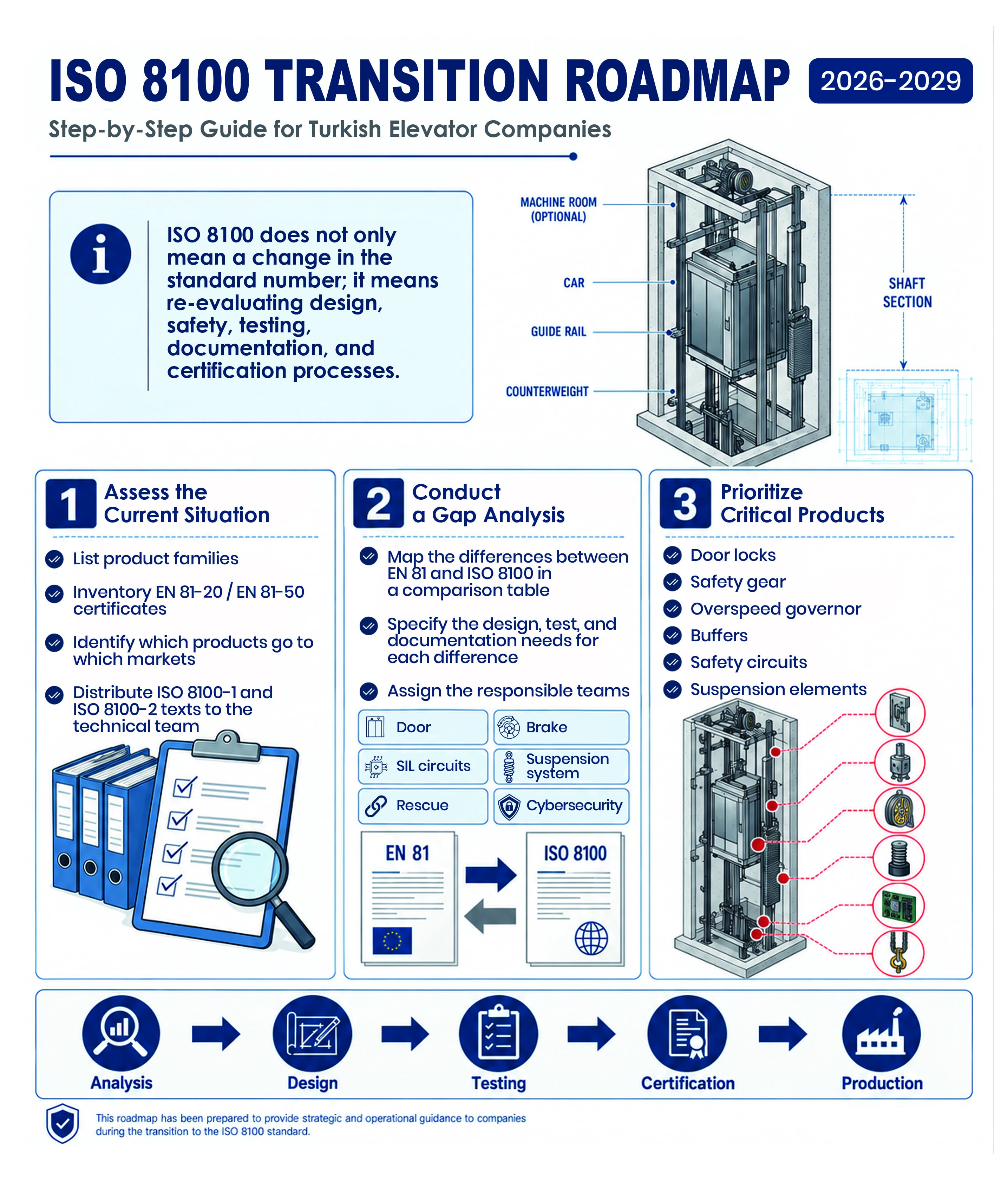
It will be important for manufacturers to compile an inventory of their certificates during the 2026–2029 period, compare their products against the provisions of ISO 8100, and pre-evaluate any necessary additional testing or revisions with accredited bodies.
During this process, gap analysis will become one of the most important preparation tools for companies.
No mandatory bulk conversion for existing elevators
The publication of ISO 8100 does not require all elevators currently in use to be retrofitted to the new standard by a specific date.
The technical framework applicable to a new elevator installed today differs from that of an existing elevator that was placed on the market in compliance with the regulations in effect at the time of its installation.
In comprehensive modernization projects, however, the importance of current safety requirements may increase. Replacing a single component will not yield the same results as modifying the elevator’s speed, capacity, drive system, or fundamental safety architecture.
For this reason, modernization projects must be evaluated based on the extent to which the changes affect the elevator’s fundamental characteristics and compliance status.
System compatibility will gain importance in the modernization market
In the coming period, maintenance and modernization companies will have to manage components from different technological generations within the same system.
The combined use of older mechanical and electronic systems with new-generation control, sensing, or safety components may require more engineering evaluation in terms of system compatibility, commissioning, and validation.
For this reason, in partial modernization projects, it will not only be the component being replaced that matters, but also how the new product will interact with the existing system.
The need for expertise in electronic systems, parameter adjustment, measurement, remote diagnostics, and technical documentation will also increase. Condition monitoring and data-driven maintenance applications may create new business models that complement traditional maintenance services.
Inventory and investment planning will also be affected
During the transition period, it may be necessary to manage products with both old and new technical revisions simultaneously for a while. Offering the same product family with different documentation or technical files depending on the market may make inventory management more complex.
For this reason, inventory planning will become a topic that must be managed collaboratively not only by production but also by technical departments, sales, export, finance, and production planning.
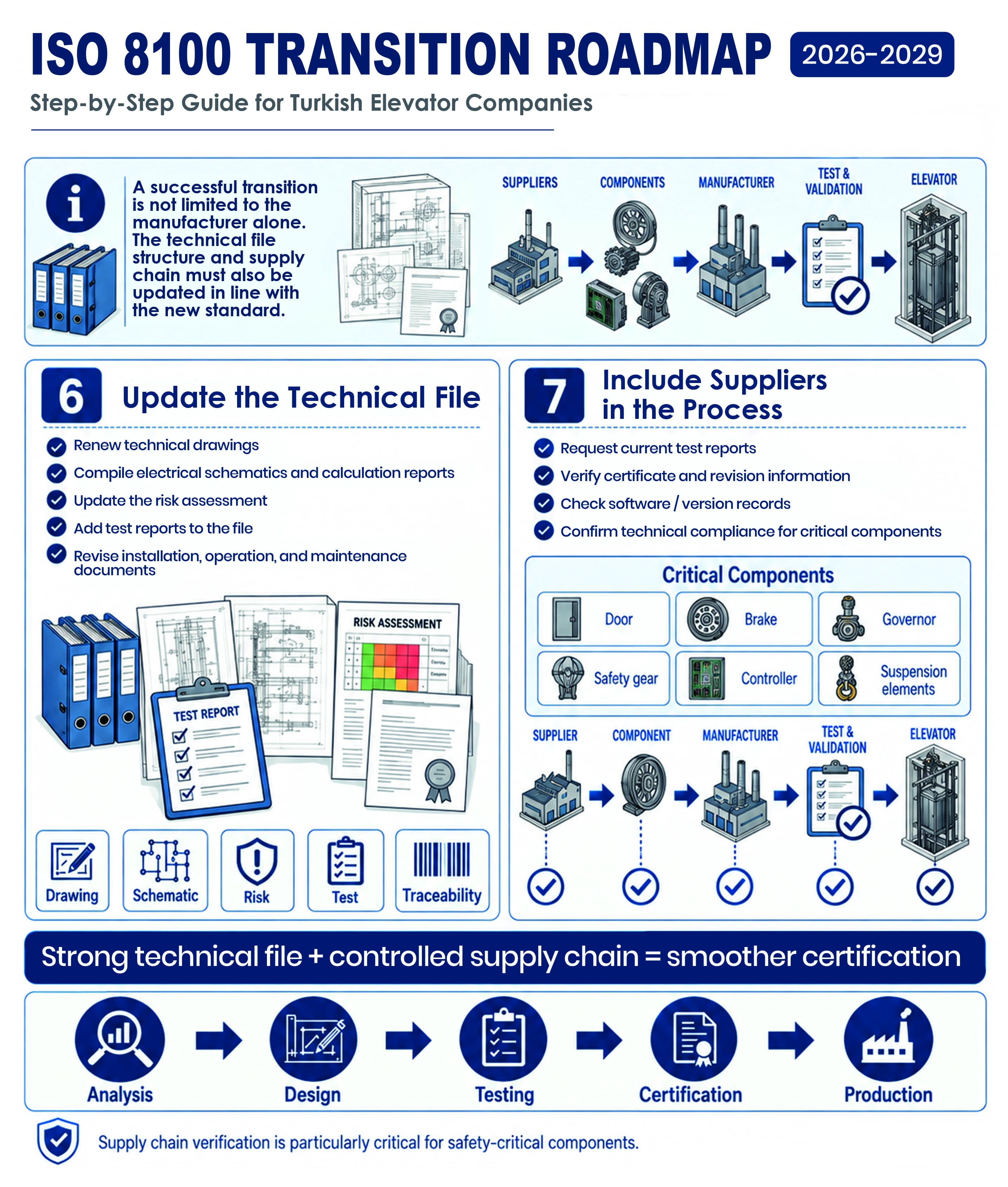
New tests, technical file updates, electronic and software capabilities, measurement infrastructure, and certification processes may create a need for additional investment on the part of companies.
However, this transformation does not mean that mechanical manufacturing has lost its importance. Material knowledge, precision manufacturing, and testing and validation capabilities will remain crucial for mechanical component manufacturers as well.
ISO 8100 can provide a common technical foundation for exports
One of the significant impacts of ISO 8100 on the Turkish elevator industry can be observed in export markets.
As the standard becomes a more widely accepted technical reference in different countries, it may reduce the need for manufacturers to develop entirely different product architectures in certain markets. This could make it possible to develop common product families that can be adapted to more countries.
However, it should not be assumed that a product compliant with ISO 8100 can be sold in every country in the world without additional procedures. National regulations, local certification requirements, and customer demands will continue to apply.
While the European market will be the region where the transition is most closely monitored, projects in the Middle East and the Gulf that make extensive use of international technical specifications may create new opportunities. In Africa, products certified according to international standards may provide a competitive advantage, while in the Asia-Pacific and North America, local standard systems will retain their importance.
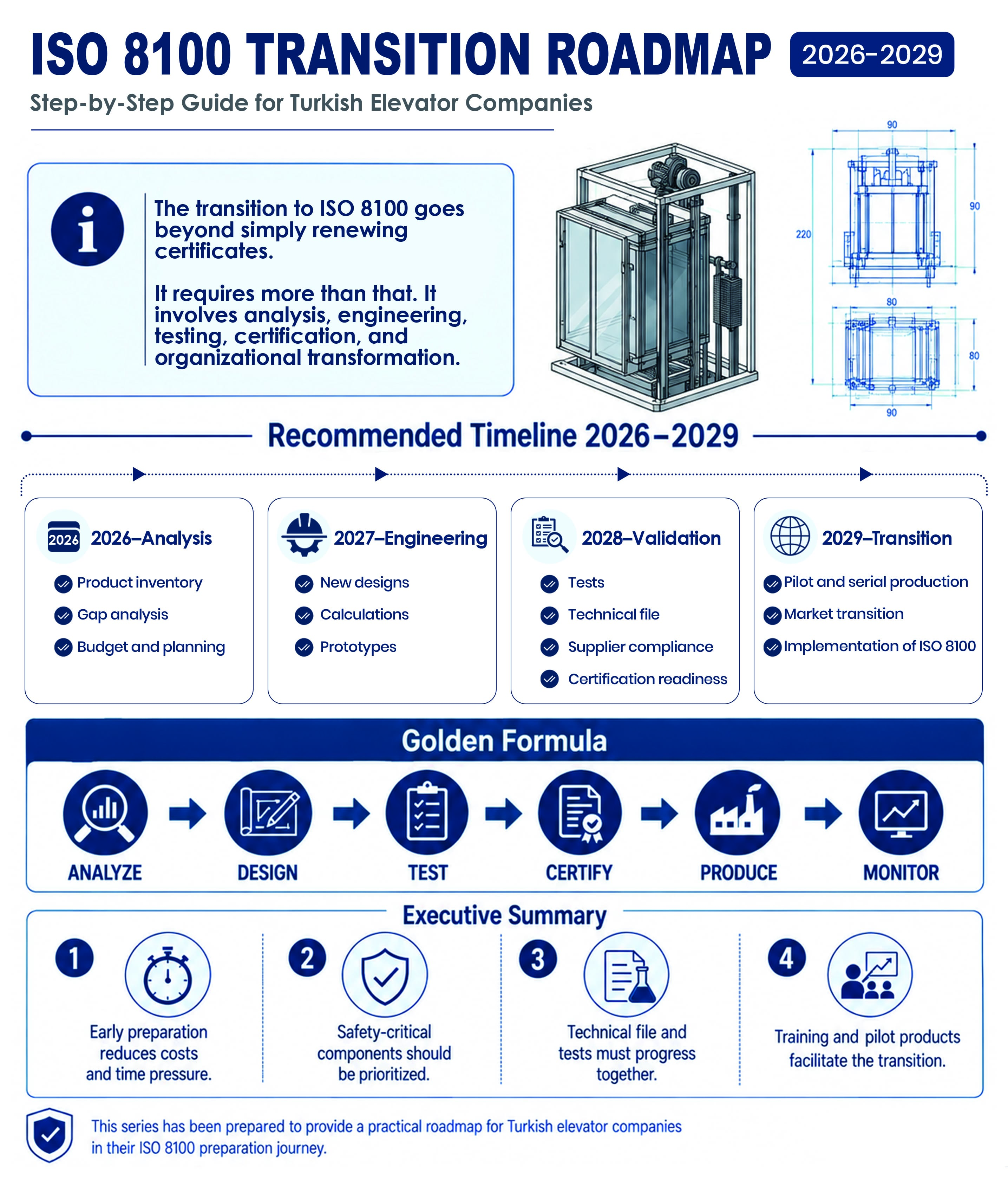
2026–2029: A period of preparation, not waiting
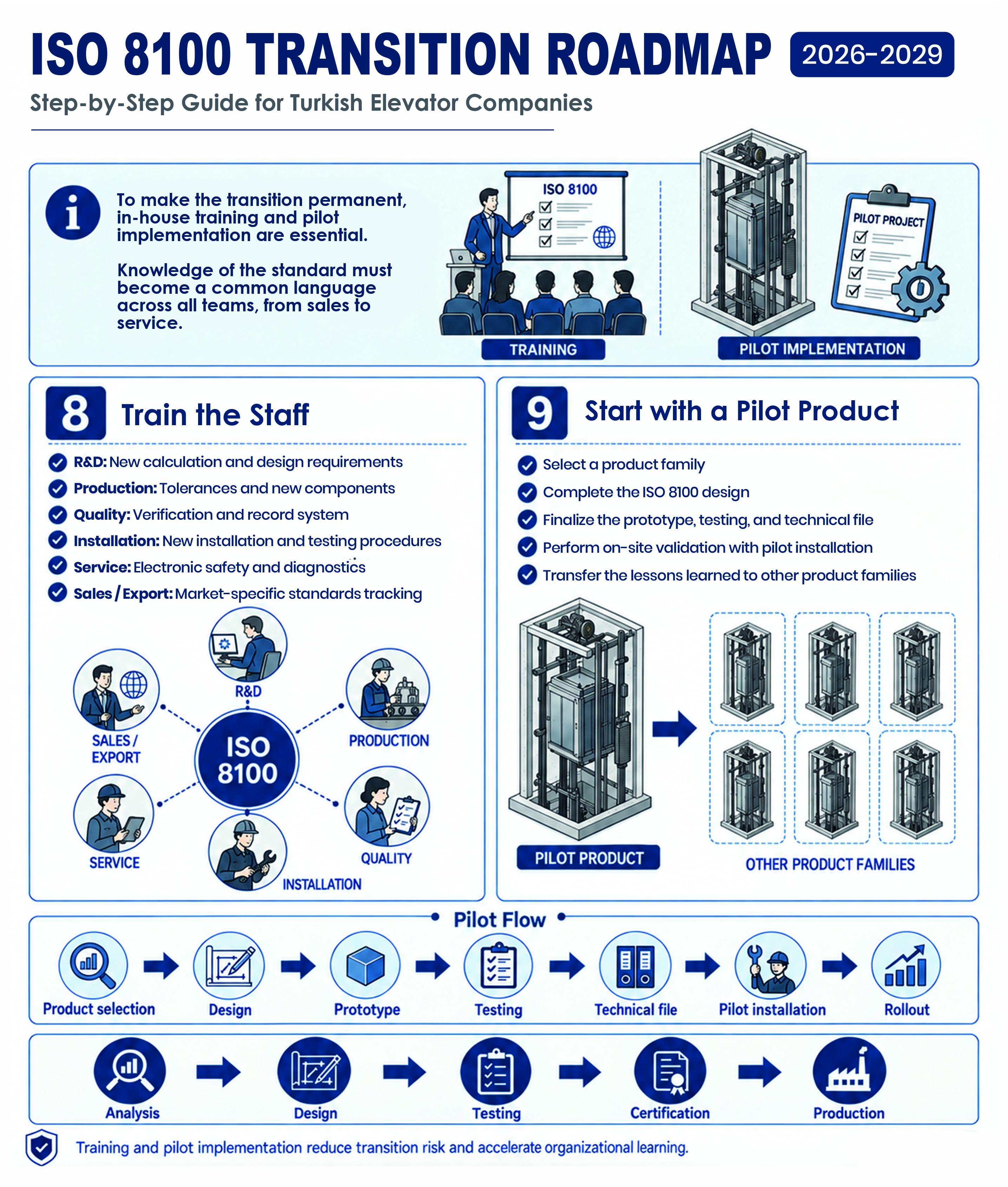
For the industry, this three-year process will not be a period where the old system suddenly comes to an end. The main focus will be on preparing existing products, documentation, testing infrastructure, and export strategies for the new technical framework.
Rather than waiting until 2029, manufacturers will need to evaluate their product portfolios starting today, identify products that may require additional testing and validation, review the scope of existing type examinations and SIL certificates, and closely monitor developments in their target markets.
The primary impact of ISO 8100 will stem not from its ability to single-handedly eliminate all technical and commercial barriers, but from its creation of a more unified international technical reference for elevator safety. How this reference will be reflected in the regulations and project specifications of different countries will be one of the most important issues to monitor during the 2026–2029 period.