
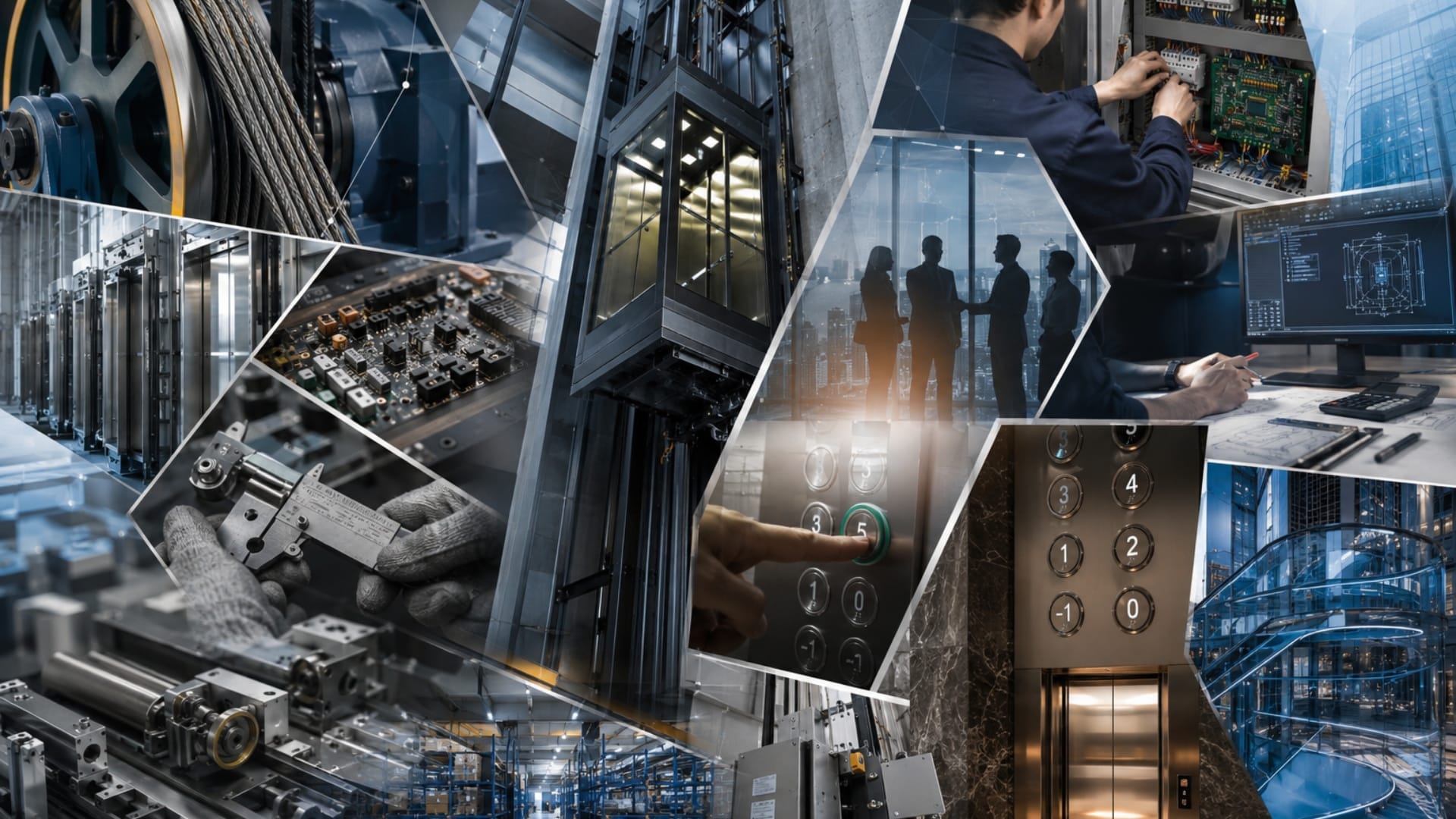
The far-reaching ımpacts of ISO 8100: The new landscape of production, ınstallation, and employment in the elevator ındustry
The Turkish elevator industry has long held a significant position in international markets thanks to its strong production capacity, logistical advantages, and export capabilities. However, global competition is no longer shaped solely by competitive pricing, rapid production, and mechanical engineering capabilities.
Safety, digitalization, energy efficiency, electronic systems, testing capacity, and technical validation are becoming increasingly decisive factors.
ISO 8100, one of the most important technical aspects of this transformation, brings not only a new era of standards to the sector but also a broad restructuring that extends from design to production, from testing to installation, and to maintenance and human resources.
However, viewing ISO 8100 merely as a shift toward electronics or a change in the standard number narrows the scope of this transformation. The new framework affects the entire technical chain of the industry—from component manufacturers to elevator companies, from engineering teams to installation and maintenance personnel, and from testing laboratories to accredited organizations.
Verification capabilities take center stage in component manufacturing
ISO 8100-2:2026 establishes a clearer framework not only for how safety-critical components are manufactured, but also for how they are calculated, tested, and validated.
Door locking mechanisms, safety brakes, overspeed regulators, buffers, safety circuits, SIL-rated circuits, protection systems against unintended car movement, upward overspeed protection devices, hydraulic safety components, and suspension systems are among the key topics covered by the new framework.
From the manufacturer’s perspective, the fundamental change at this point is not merely to produce a product that functions correctly physically. It is necessary to demonstrate through calculations, testing, and technical documentation that the product can fulfill its safety function under various operating and failure conditions.
This approach makes testing infrastructure, engineering calculations, and technical file management an integral part of production, particularly for companies focused on mechanical manufacturing.
A system approach to doors, brakes, and safety components
Safety in elevator doors is no longer evaluated solely based on the opening and closing of the door panels. Verifying that door locking mechanisms operate safely under the required conditions has also become a priority. Therefore, mechanical design, locking mechanisms, electrical safety connections, and testing processes must be evaluated together.
A similar shift is observed in braking systems. Brakes are no longer treated solely as mechanical stopping elements. Motion detection, prevention of unintended movement, the interaction between the motor and the drive, and the operation of safety circuits are all becoming integral parts of the same safety architecture.
In the case of unintended cabin movement, a safety chain—rather than a single component—takes on greater importance. The brake, speed or position detection system, safety circuit, and control structure must all function correctly together.
In the case of overspeed regulators and parachute systems, it is not just the activation of the product that matters, but also the verification of safety performance under various operating conditions.
This situation requires the disciplines of mechanical, electrical-electronic, and control engineering to work more closely together in product development processes.
A technical structure more open to new technologies in suspension systems
Suspension systems also represent a significant area of change in the elevator industry. The use of suspension components made of different materials and with different constructions, alongside traditional steel ropes, raises questions about how these products should be validated and under what conditions they should be taken out of service.
With ISO 8100-2:2026, the clarification of validation methods for suspension and balancing components other than steel wire ropes creates a more transparent technical foundation for next-generation suspension technologies.
Manufacturers will be required to provide technical data not only on load-carrying capacity but also on safety factors, tensile behavior, changes during use, and criteria for decommissioning.
While this approach creates new product development opportunities for companies developing alternative suspension systems, it also underscores the importance of testing and validation capabilities.
Mechanical components remain important
The fact that the new standard structure makes more room for electronic safety does not mean that traditional mechanical components have lost their importance.
Buffers, hydraulic valves, guide rails, suspension systems, and various mechanical safety components will continue to be key parts of the fundamental safety chain in the new era.
For example, in buffer production, it is no longer sufficient to merely meet physical dimensions; it has become increasingly important to prove through testing that the product can demonstrate the required energy absorption performance.
In hydraulic systems, material strength, behavior under pressure, and failure conditions—as they pertain to pipe rupture valves, check valves, pistons, cylinders, and fasteners—constitute important aspects of the technical evaluation.
Consequently, the fundamental focus of the ISO 8100 era is not the replacement of mechanical systems by electronic systems, but rather the more systematic validation of both types of systems.
From PESSRAL to SIL-Rated safety circuits
One of the notable topics on the electronic safety front is the consideration of structures previously defined as PESSRAL within the framework of SIL-rated safety circuits.
In applications where programmable electronic systems perform safety functions, it is not only the operation of the circuit that matters, but also how the system behaves in the event of a failure and whether it maintains the intended safety level.
This development underscores the importance of software and functional safety expertise for companies that manufacture control panels, electronic boards, sensors, encoders, and safety modules.
However, this does not mean that all safety systems will become electronic. The new framework emphasizes the evaluation of mechanical, electronic, and software-based safety solutions within the same verification approach.
System integration is becoming critical for package elevator manufacturers
For packaged elevator manufacturers, one of the most significant aspects of this change will be system integration.
The fact that the motor, brakes, control system, doors, sensors, and safety devices each meet their respective technical requirements does not, on its own, guarantee that the completed elevator is safe. The compatible operation of these components within the system must also be verified.
Consequently, the role of the packaged elevator manufacturer is expanding from that of a supplier who simply brings together different products to that of an engineering organization that manages system architecture, component compatibility, and the integration of safety functions.
In particular, the widespread adoption of electronic safety functions requires closer management of the technical relationships between control, braking, door, position, and speed sensing systems.
In this process, technical documentation, component selection, commissioning, and system testing will become more prominent within the package manufacturer’s area of responsibility.
Computational capacity is gaining importance in design
In the new era, it will no longer be sufficient to limit elevator design solely to shaft dimensions, load capacity, speed, and the number of stops.
Suspension systems, guide rails, traction conditions, safety components, hydraulic systems, and electronic safety functions will need to be evaluated together starting from the design phase.
Therefore, for engineering firms, it is becoming crucial not only to be familiar with the provisions of the standard but also to be able to support design decisions with engineering calculations and accurately assess the technical limitations of the solutions employed.
Particularly in projects that utilize alternative suspension systems, new materials, and electronic safety functions, the disciplines of mechanical, electrical-electronic, and control engineering will need to collaborate more closely.
A new era in testing and conformity assessment
One of the areas where the impact of ISO 8100 will be felt most strongly will be in testing and conformity assessment processes.
In the new era, evaluation will not be limited to simply checking whether a component has been manufactured to the correct dimensions. The conditions under which the safety function operates, the method used to verify it, and how the system behaves in the event of a failure will also be examined.
For this reason, laboratories will need to possess not only physical testing equipment but also the technical expertise to evaluate electronic safety systems and next-generation components.
Ensuring that technical documentation, calculations, test reports, and validation records support one another will be a crucial part of the conformity assessment.
Consistency in application among notified bodies is critical
One of the key issues manufacturers may face during the transition period is how different notified bodies will interpret the new standard.
While existing test reports may be sufficient for some products, additional testing or verification may be required for others. However, if the same technical situation is evaluated very differently by different bodies, this could create time, cost, and uncertainty for manufacturers.
Therefore, it is important to develop a common approach to how existing documentation will be evaluated, which changes will require additional testing, and how the technical provisions of the new standard will be interpreted.
Laboratory capacity may become a strategic factor
Turkey has significant experience in testing and conformity assessment under EN 81-20, EN 81-50, and the Elevator Regulation. However, the key question regarding the transition to ISO 8100 is not merely whether the tests can be performed, but whether the potential increase in demand can be met in a timely manner.
Based on manufacturers’ gap analyses, while existing tests may be sufficient for some products, new testing requirements may arise for certain components. As the transition timeline progresses, a large number of companies turning to laboratories simultaneously could create capacity pressures.
Furthermore, if the required tests are not covered by the accreditation scope of laboratories in Turkey, testing abroad could incur additional costs in terms of sample transportation, customs, foreign currency-based testing fees, and time.
Validation is just as important as implementation during assembly
One of the most significant on-site impacts of ISO 8100 will be seen in the installation processes.
Door locks, brakes, suspension components, safety devices, and electronic safety circuits must be installed in accordance with the conditions specified by the manufacturer.
It will become even more important for assembly personnel to be able to read technical documents, apply tolerances correctly, and perform measurements and tests.
Especially in systems where mechanical and electronic safety functions work together, simply installing the component correctly will not be sufficient. During commissioning, the interoperability of sensors, safety circuits, and different systems will also need to be verified.
For this reason, in addition to experience, the use of measurements, technical records, and documentation will become more prominent in the assembly process.
New technical knowledge needs for maintenance companies
New technologies will transform not only new installations but also maintenance processes.
The widespread adoption of electronic safety circuits, sensors, various suspension systems, and next-generation control technologies will increase the variety of systems that maintenance personnel encounter.
Monitoring brake and safety functions, determining criteria for decommissioning suspension components, checking door locks, and performing electronic fault diagnosis may require more technical knowledge.
Mechanical field experience will retain its importance, but the ability to interpret electronic systems, evaluate measurement results, and follow manufacturer documentation will need to be added to this experience.
A new era of competencies in human resources
One of the most significant impacts of ISO 8100 on the industry will be seen in human resources.
While mechanical field knowledge built up over many years will retain its value, the widespread adoption of electronic systems, measurement devices, and digital tools will expand the scope of technical personnel’s responsibilities.
Installation, maintenance, testing, and commissioning teams will need not only to perform tasks but also to understand the technical limitations of the components they use, interpret measurement results, and follow technical documentation.
Therefore, the fundamental need in this new era will not be to replace the field knowledge of experienced technicians with electronic and digital competencies, but rather to develop both areas in tandem.
Particularly for small and medium-sized companies, gap analysis, the preparation of technical files, and keeping up with new testing requirements may require more resources. Industry-specific training, technical guides, and joint awareness-raising activities will be crucial in this regard.
Cybersecurity is becoming a key focus
As remote connectivity, sensors, software-based functions, and data collection systems become more widespread in elevators, cybersecurity is also emerging as one of the industry’s key priorities.
However, it is incorrect to view cybersecurity as a direct requirement imposed by ISO 8100-1 or ISO 8100-2.
While ISO 8100 primarily focuses on the manufacturing, installation, component design, calculation, verification, and testing processes of elevators, information security, access control, software updates, and system integrity in connected systems are addressed through separate technical studies and standards.
Nevertheless, as elevators become increasingly connected, manufacturers and system providers must consider digital security in addition to mechanical and functional safety.
The transformation encompasses the entire technical chain
It is not sufficient to define the change ISO 8100 has brought about in the industry merely as a “transition from mechanics to electronics.”
For component manufacturers, verification capabilities are key; for elevator package companies, system integration; for project teams, engineering calculations; for laboratories and accredited bodies, technical evaluation capabilities; for installers, precise installation and measurement; for maintenance companies, knowledge of new systems; and for field personnel, the simultaneous development of mechanical and electronic expertise is paramount.
While traditional mechanical safety products retain their importance, their relationship with electronic controls, software, measurement, and technical documentation is growing stronger.
The fundamental shift of the ISO 8100 era will not be the replacement of one technology by another, but rather the ability to calculate, test, verify, and track safety performance in a more systematic manner—from design to production, testing to installation, and maintenance.